Spring Snowmelt Sewer Line Strain in Grand Forks ND
Grand Forks winters are long and brutal, and by the time March and April arrive, the accumulated snowpack starts doing something your sewer line has been dreading all season. As temperatures climb above freezing and the Red River Valley thaw begins in earnest, billions of gallons of snowmelt start pressing down into already-saturated ground. That slow, heavy process puts enormous strain on buried infrastructure — and the sewer lines running beneath older Grand Forks neighborhoods are often the first to show it.
Why Snowmelt Creates Unique Sewer Stress in Grand Forks
Most homeowners think about sewer problems in terms of what goes down the drain. But springtime sewer failures in Grand Forks are frequently caused by what surrounds the pipe, not what flows through it. When the ground is frozen solid through January and February, moisture has nowhere to go. Once the thaw begins, that moisture moves rapidly downward, saturating the soil layer where your lateral sewer line sits — typically four to six feet below grade.
Saturated soil shifts. It expands slightly, contracts unevenly, and loses the structural support that keeps buried pipes in alignment. For homes with older clay tile or cast iron sewer laterals, this seasonal ground movement can crack pipe sections, separate joints, or allow roots that expanded during warmer months to exploit new gaps. The Red River Valley's predominantly clay-heavy soils make this cycle particularly harsh because clay retains moisture longer than sandy or loam soils and transmits hydrostatic pressure more aggressively to anything buried within it.
The Infiltration Problem Nobody Talks About
Beyond pipe movement, snowmelt introduces a second serious threat: groundwater infiltration into the sewer system itself. Clay tile joints and aging concrete sewer pipe are not watertight. As groundwater levels rise during the spring thaw, water finds its way into your lateral through hairline cracks and loose mortar. This groundwater mixes with household sewage inside the pipe and dramatically increases the volume your system must handle.
The Grand Forks municipal sewer system sees a measurable surge in flow every spring because of this exact problem. When private laterals are compromised, they contribute groundwater infiltration directly into the main sewer lines. If the municipal system is already handling elevated spring flows and your lateral adds additional groundwater, the result can be backpressure that works against the gravity flow your home's system depends on. That backpressure is what eventually pushes sewage back up through your lowest fixtures — usually a basement floor drain or a ground-floor toilet.
Warning Signs to Watch for During Thaw Season
The window between early March and mid-May is when Grand Forks homeowners should pay closest attention to how their plumbing behaves. Several specific warning signs suggest snowmelt is already stressing your lateral line.
- Slow drains throughout the house: If every fixture is draining sluggishly rather than just one, the problem is downstream of your home in the lateral, not a localized clog.
- Gurgling sounds after flushing: Air trapped in the line as drainage backs up produces a distinctive gurgling in nearby fixtures. Hearing it from a sink while the toilet flushes is a red flag.
- Sewage odors in the basement: As groundwater infiltrates a compromised pipe, it can displace sewer gases upward through unused floor drains and open cleanouts.
- Water pooling near the sewer cleanout: If you can see your exterior cleanout cap and notice standing water or soft, saturated soil nearby, it may indicate a leak or separation point.
- Unusually wet ground along the sewer line path: Even when surrounding areas are drying out, a section of yard that stays soggy long after snowmelt has otherwise absorbed may be receiving sewage from a cracked lateral.
None of these signs guarantee a failure is imminent, but any combination of two or more during spring thaw warrants a professional camera inspection before a minor problem becomes a full backup.
How Age and Material Shape the Risk Profile
Not every Grand Forks home carries the same spring risk. Homes built before 1970 are statistically more likely to have clay tile laterals, which were the standard installation material for most of the twentieth century. Clay tile performs reasonably well under stable conditions, but its jointed construction — short pipe sections connected with bell-and-spigot joints — creates dozens of potential infiltration points along a typical residential lateral run.
Homes in the older core neighborhoods north and south of downtown, along 4th and 5th Avenue corridors, or in the Near Northside area are particularly likely to be sitting on original clay tile infrastructure. Even homes that had above-grade work done in recent decades may still have the original buried lateral connecting to the city main.
Homes built after 1980 with PVC laterals are significantly more resistant to infiltration and joint separation, but PVC is not immune to root intrusion or physical damage from ground shifting. Spring inspections remain worthwhile even for newer installations if your property has mature trees near the sewer line path.
What Professional Inspection Reveals
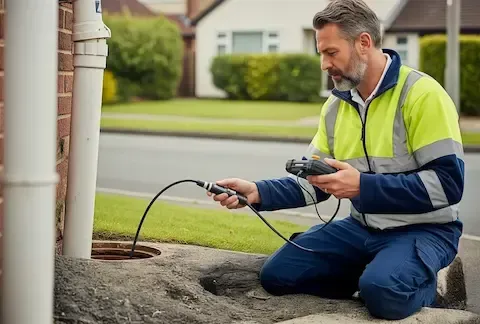
A sewer camera inspection during or just after the spring thaw period gives you a clear picture of what the winter and snowmelt season did to your lateral. A plumber feeds a waterproof camera through the cleanout access and runs it the full length of your lateral to the city main. The camera identifies joint separations, root intrusion, low spots where water pools (called bellies), and active cracks that are allowing groundwater in.
For homes where Sewer Line Repair is indicated, the approach depends on the severity and location of damage. Minor infiltration at a single joint can sometimes be addressed with a cured-in-place liner that seals the interior of the existing pipe without excavation. More significant damage, root-filled sections, or collapsed pipe requires spot repair or full lateral replacement.
Understanding the condition of your line before a backup happens keeps you in control of the timing and scope of the work. Emergency sewer repairs during peak spring demand cost more, take longer to schedule, and happen under the worst possible conditions — often with a flooded basement already in progress.
Spring Maintenance That Reduces Risk
A few practical steps during the thaw season can reduce the load on a marginal sewer lateral. Avoid running high-volume appliances like washing machines or dishwashers during peak snowmelt periods, particularly in late March when melt rates are fastest. Space out laundry loads throughout the week rather than running multiple cycles in sequence. Keep your basement floor drain trap primed with water so the trap seal is intact and sewer gas cannot enter even if backpressure develops.
For background on how regional flooding conditions connect to local sewer system performance, the Red River Valley Sewer Backups in Grand Forks post covers the broader context of spring flooding and sewer backup patterns across the valley.
Spring in Grand Forks is worth protecting. Paying attention to how your plumbing behaves during the first warm weeks of the year is one of the most useful things a homeowner can do — the warning signs are readable, the timeline is predictable, and acting before a backup puts you in a far better position than reacting after one.
